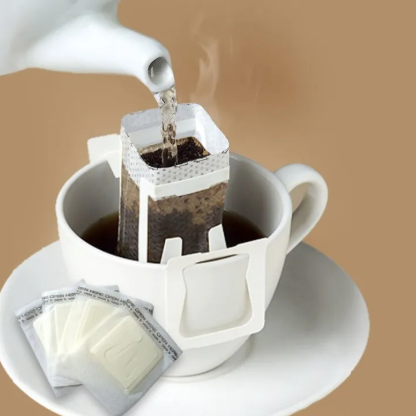
Freshness Management for Ecuador Ground Coffee: Drip Coffee Bag Packaging
Ecuador coffee can offer diverse specialty coffee products through different origins, growing environments, processing methods and roast strategies. For growers, roasters, packing companies and export brands, every stage between roasting and consumer brewing can influence final aroma and flavor.
Ground coffee is particularly sensitive. Compared with whole beans, it has more surface area exposed to air, making aroma changes more likely. For this reason, developing drip coffee bags is not only about creating a convenient single-serve product. It is also about establishing a freshness-management process from roasting and grinding through dosing and sealed packaging.
From Post-Roast Handling to Outer-Envelope Sealing
For Ecuador ground coffee, product development can begin with one practical question: how can flavor be better protected after roasting? Drip coffee bags place a measured dose of ground coffee in a filter bag, then protect it with an individual outer envelope. This reduces the need for consumers to repeatedly open a large pack of ground coffee.
Brands can develop several product formats:
- Single-origin specialty coffee: Products that highlight region, process method, roast date and flavor notes;
- Everyday filter coffee: Balanced, easy-to-brew products for home and office use;
- Coffee discovery boxes: Single-cup assortments of different lots or roast levels;
- Hotel and business hospitality coffee: Individually packed bags with simple preparation guidance;
- Export gift collections: Multi-pack formats with consistent branding for cross-border retail and gifting.
For every product type, the outer envelope is not only a printed package—it is part of the quality-protection system.
Grind Size Controls Flow and Flavor
Drip coffee bags are filter-brewing products. Their coffee grind should not simply copy espresso, French press or other brewing settings. Grind size must be defined together with filter material, coffee dose, pouring speed and target cup volume.
Coffee that is too fine may create slow flow, clogging, bitterness or over-extraction. Coffee that is too coarse may produce weak extraction and a lighter cup. Brands should test final Ecuador ground coffee with real packaging materials rather than relying only on theoretical values.
A standard brewing specification can include:
- Net coffee content per bag;
- Grind particle range;
- Recommended water temperature;
- Total water volume;
- Staged pouring method;
- Target brewing time;
- Aroma, sweetness, acidity and aftertaste results.
These standards support stable packaging production and a more predictable cup for consumers.
Key Value of a Drip Coffee Bag Packaging Machine
Depending on configuration, a drip coffee bag packaging machine can integrate automatic coffee dosing, filter-bag forming, hanging-ear attachment, individual outer-envelope sealing and optional nitrogen flushing. For Ecuador ground coffee projects focused on specialty quality and freshness, the key value is stability and repeatability.
Important points to validate include:
- Consistent coffee dosing
Roast degree, particle distribution, density and static charge affect coffee flow. Continuous trials should use the final coffee product. - Filter-bag water flow
Filter-bag construction should match coffee grind and dose to control pouring flow and extraction results. - High-barrier outer-envelope protection
Individual envelopes help reduce the impact of oxygen, moisture, light and odor transfer on ground coffee. - Optional nitrogen flushing
Projects requiring stronger aroma protection or longer logistics cycles may assess nitrogen flushing to reduce oxygen inside the package. Actual freshness performance should be confirmed through finished-product and storage tests. - Reliable seals and pack appearance
Outer-envelope seals should be neat and secure to reduce the risks of oxygen ingress, powder leakage and transport damage while supporting shelf presentation.
Make Packaging Part of Product Transparency
Specialty coffee consumers increasingly value transparent product information. Drip coffee bag envelopes can present origin, process method, roast level, flavor notes, net content, date marking, batch information and brewing guidance. For export projects, language, origin claims and other compliance information should be reviewed for each target market.
Brands should avoid overstating terms such as “fresh,” “sustainable” or “specialty.” Communication should be supported by real supply-chain information, packaging materials and test results. Verifiable information is more effective for building long-term consumer trust.
Complete Validation from Trial Packing to Shelf Life
Before equipment purchase or commercial production, conduct full trials using final coffee, filter bags and outer-envelope film, including expected storage and transport conditions. Check:
- Is coffee net content consistent in every bag?
- Are filter bags and hanging ears neat, secure and easy to use?
- Are outer-envelope seals reliable?
- Does transport simulation reveal powder leakage, bag damage or deformation?
- Are water flow, aroma and flavor consistent when brewed as instructed?
- Does the product still meet internal quality standards after the planned storage period?
Packaging Solutions from Xiamen Sengong
Xiamen Sengong Packing Equipment Co.,Ltd provides packaging equipment solutions for drip coffee bags and single-serve ground coffee products. Brands can select suitable configurations according to coffee grind, per-pack dose, output targets, filter-bag specifications, outer-envelope formats and freshness requirements.
Learn more:
- Xiamen Sengong Packing Equipment Co.,Ltd – Quicker Pack
- Xiamen Sengong Packing Equipment Co.,Ltd – VIPacker
Conclusion
Developing drip coffee bags for Ecuador ground coffee is fundamentally about combining origin character with freshness management in a single-serve product. With a compatible grind profile, reliable high-barrier envelopes and stable packaging equipment, brands can carry coffee quality more effectively from post-roast handling to the consumer’s cup.