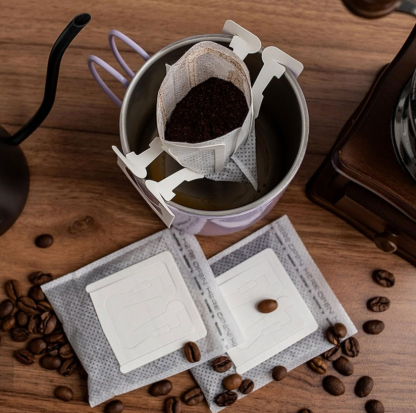
From Briki to Drip Bags: A Hot-and-Iced Approach to Greek Coffee Packaging
Greek coffee culture embraces more than one brewing method. Traditional coffee is prepared in a small pot called a briki, while modern cold drinks such as freddo espresso use espresso as their foundation.
For roasters and coffee brands, this variety suggests a product development opportunity: a single-cup format that requires no coffee machine and supports both hot and iced preparation.
Drip coffee bags offer one possible answer. However, developing a Greek-inspired drip product involves more than repackaging existing coffee grounds. Grind size, filtration, brewing instructions, and package construction must work together. An ultrasonic drip coffee bag packing machine helps turn that validated concept into a consistently packaged product.
1. Define the Product Before Designing the Package
Traditional Greek coffee and drip coffee from a Greek brand are not interchangeable descriptions.
Pot brewing and drip filtration use different extraction methods, producing different textures and drinking experiences. A brand can introduce “drip coffee from a Greek roaster” or a “Greek-inspired filter blend,” but should not suggest that a hanging-ear bag exactly reproduces briki coffee.
Origin information needs the same care. If beans are grown elsewhere and roasted in Greece, identify those locations separately rather than implying that the beans were grown in Greece.
A precise identity keeps the article, retail packaging, and product page consistent.
2. Match the Grind to the Filter Bag
A mismatch between grind and filtration can undermine an otherwise promising product.
If an existing coffee is ground too finely for the chosen filter, it may drain slowly, retain water above the coffee bed, or produce inconsistent results. The first response should be to examine particle size, fines, dose, and filter permeability—not automatically replace the packing machine.
Keep the blend and target dose fixed while comparing grind settings. Record whether:
- Water drains smoothly after pouring.
- Overflow or noticeable particle passage occurs.
- The bag provides sufficient pouring space.
- Repeated brews deliver comparable strength and flavor.
Repeatable brewing performance establishes a meaningful quality target for automated packaging.
3. Develop Two Brewing Instructions, Not One Recipe with Added Ice
A Greek-inspired drip coffee product can offer both hot and iced preparation. However, the iced instructions should do more than tell the customer to add ice.
Hot brewing depends on water temperature, volume, and pouring pattern. Iced preparation must also account for dilution as the ice melts. Pouring a full hot-coffee recipe over a large amount of ice may produce a noticeably weaker drink.
One approach worth testing is to brew with hot water through the drip bag directly into a heat-resistant cup containing ice. Adjust the brewing water and ice together, then validate the recipe against the coffee, dose, and desired flavor.
Describe the result as “iced filter coffee” or “iced pour-over coffee,” not freddo espresso. It does not use espresso’s pressure-based extraction and should not promise the same foam or texture.
4. Where Ultrasonic Packaging Technology Fits
Depending on the model and configuration, equipment can connect measured filling, inner filter bag forming and sealing, and individual outer-envelope packaging.
Ultrasonic sealing is used with compatible inner filter materials. High-frequency mechanical vibration creates a bond at the joining area. The process is not entirely heat-free, and not every filter paper or nonwoven material is suitable.
Evaluate the two packaging layers separately.
The inner bag supports brewing. Important factors include permeability, seam strength, opening convenience, and the stability of the hanging supports on a cup.
The outer envelope supports storage protection. Important factors include barrier properties, seal integrity, and performance after transport. It may use heat sealing appropriate to the packaging film, rather than ultrasonic sealing.
The technology label is only a starting point. Trials using the intended coffee and materials provide the practical basis for machine selection.
5. Packaging Should Explain the Product, Not Just Suggest a Destination
Blue-and-white colors or coastal illustrations can establish a visual theme. Clear instructions make the product usable.
For a hot-and-iced range, divide the back of the package into two easy-to-follow sections. Each should state the validated water quantities, preparation steps, and relevant handling guidance.
Also present bean origin, roasting or packing information, net weight, and batch identification clearly. Chocolate, nut, or fruit tasting notes should reflect actual sensory evaluation and should not imply that those ingredients have necessarily been added.
For hotel or travel retail applications, test common cup sizes and check whether first-time users understand how to open and position the filter. Attractive packaging still needs to perform during the first brew.
6. Evaluate Finished Packs, Not Just Machine Speed
When purchasing an ultrasonic drip coffee bag packing machine, nominal output should not be the only comparison.
Useful acceptance checks include dose variation, coffee trapped in seams, wet filter strength, outer-envelope integrity, and cleaning between batches. If grounds enter the sealing area, examine filling timing and dust management rather than relying only on increased sealing power.
Ultrasonic sealing alone does not establish shelf life. Time after grinding, coffee degassing, film barrier performance, and storage conditions all require consideration.
If nitrogen flushing is required, confirm the selected equipment configuration and evaluate finished packs. A nitrogen-flushing claim is not, by itself, evidence for a fixed freshness period.
7. Discuss the Packaging Project with Real Samples
Xiamen Sengong Packing Equipment Co., Ltd offers beverage packaging equipment, including drip coffee packing machines. Brands can also explore related equipment through its VIPacker website.
The C19H Ultrasonic Drip Coffee Inner and Outer Bag Packing Machine is one model available for further discussion. Bag formats, material compatibility, operating speed, and optional functions should be confirmed through sample trials and an agreed technical proposal.
Before requesting a quotation, prepare coffee samples, the target dose, inner and outer bag dimensions, packaging samples, and planned output. This makes the discussion about an actual product rather than a machine name and specification sheet.
Conclusion
Greek-inspired drip coffee does not need to replace traditional beverages to offer value. Its opportunity is to provide a clearly described, convenient alternative.
From hot and iced recipes to grind compatibility and protective packaging, each decision shapes the final cup. Combining a tested product design with a suitable ultrasonic drip coffee bag packing machine can turn cultural inspiration into a dependable everyday coffee product.