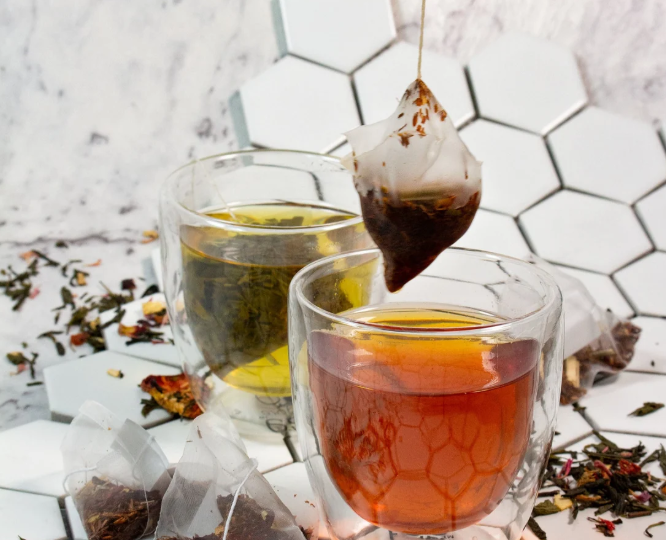
Polish Tea Packaging: Premium Pyramid Tea Bags for Diverse Single-Serve Tea Products
The Polish tea market offers room for a broad range of products. Black tea supports everyday drinking, green tea offers a fresh profile, fruit tea can combine fruit, petals, and spices, while herbal tea gives consumers more botanical blend options. For tea brands, the key challenge is ensuring that different ingredients perform consistently in packaging, brewing, and retail presentation.
Pyramid tea bags provide a format that combines function and visual appeal. A three-dimensional filter bag holds tea leaves, petals, fruit pieces, and botanical ingredients with more space to expand in hot water. Compared with a traditional flat tea bag, a pyramid bag is especially suitable for larger leaves, flowers, and pieces.
An automatic pyramid tea bag packing machine can integrate dosing, filter-bag forming, sealing, string-and-tag attachment, and individual outer-pouch packaging into a continuous production process.
Why Are Polish Tea Products Suitable for Pyramid Tea Bags?
Consumers often look for convenience, flavor, hygiene, and attractive packaging when buying tea bags. Pyramid bags can provide a fuller loose-leaf and botanical brewing experience without requiring a teapot or infuser.
Suitable product formats include:
- Black tea, flavored black tea, and specialty blends;
- Green tea and green tea with fruit or floral ingredients;
- Fruit tea containing fruit pieces, peels, petals, or spices;
- Herbal tea with leaves, flowers, roots, and botanical ingredients;
- Retail cartons, tasting sets, and seasonal gifts;
- Hotel, food-service, office, and meeting tea;
- E-commerce, subscription, and travel products;
- Private-label and contract-packed tea.
Individual outer pouches can display tea name, ingredients, net weight, brewing guidance, storage details, batch information, and the brand story.
Select Packaging Parameters by Ingredient Form, Not Only Tea Category
Two products in the same tea category may behave very differently during automatic packaging. The key is the actual ingredient form.
For example:
- Whole leaves may require a larger pyramid bag;
- Lightweight petals may require changes to dosing and vibration settings;
- Fruit pieces and roots may affect feeding speed;
- Mixed formulas require attention to distribution of ingredients in each bag;
- Delicate leaves should not be unnecessarily compressed or broken.
Product development should start with ingredient particle size, density, moisture content, flowability, and target cup size, then define fill weight, filter material, bag dimensions, and machine settings.
Packaging Priorities by Tea Type
Black Tea: Consistent Brewing and Full Body
Black tea fill weight should reflect leaf grade, blend style, and target cup size. Pyramid filters can give larger leaves room to expand. Outer pouches should protect aroma and provide clear water-temperature and steeping guidance.
Green Tea: Barrier Protection and Gentle Brewing
Green tea can be affected by moisture, oxygen, light, and external odors. Individual pouches should provide suitable barrier protection. Clear instructions for water temperature and steeping time can help consumers achieve a more balanced cup.
Fruit Tea: Consistent Ingredient Balance in Every Bag
Fruit tea often includes fruit pieces, peels, petals, and spices with different densities. Brands should test ingredient distribution in each bag and avoid formula separation that produces inconsistent flavor. Transparent or semi-transparent filters can display ingredients and reinforce a natural, premium appearance.
Herbal Tea: Ingredient Flowability and Label Compliance
Herbal leaves, petals, and roots may be lightweight, bulky, or irregular. Real formulas should be used to test stable feeding and fill weight. Labels should accurately state ingredients, storage, brewing guidance, and required warnings, without unsupported health or therapeutic claims.
How Does an Automatic Pyramid Tea Bag Packing Machine Work?
An automatic pyramid tea bag packing machine can continuously complete the following stages:
- Feed tea or botanical blend ingredients into the system;
- Dose the preset net weight;
- Form a pyramid tea bag from nylon, PLA, non-woven fabric, or another suitable filter material;
- Seal and cut the filter bag;
- Attach a string and tag;
- Transfer the tea bag into an individual outer pouch;
- Heat-seal, cut, and discharge the finished product;
- Add optional date, batch, or traceability coding.
Automation can reduce manual handling and improve consistency in fill weight, filter-bag shape, string-and-tag placement, and pouch-seal quality.
How Does the Outer Pouch Affect Product Quality?
An individual outer pouch is not only for branding; it also protects tea quality. Materials should be selected according to formula, target shelf life, transportation distance, and storage conditions.
Key validation points include:
- Moisture, oxygen, and light barrier performance;
- Heat-sealing stability;
- Compatibility with bag forming, cutting, and printed registration;
- Package integrity in actual storage and logistics conditions.
For products positioned around premium aroma or longer distribution cycles, real-product testing of pouch material and seal quality is essential.
Polish Tea Pyramid Tea Bag Packaging Solutions
Xiamen Sengong Packing Equipment Co.,Ltd provides pyramid tea bag packing equipment and related solutions for tea brands, black tea and green tea producers, fruit tea and herbal tea businesses, private-label projects, and packing service providers.
Before purchasing equipment, run a trial with the actual tea formula, filter material, strings, tags, and outer-pouch film. Confirm dosing consistency, filter-bag sealing, pouch integrity, cleaning accessibility, and brewing performance.
Learn more about equipment and packaging solutions:
- Xiamen Sengong Packing Equipment Co.,Ltd – Quicker Pack
- Xiamen Sengong Packing Equipment Co.,Ltd – VIPacker
Conclusion
Pyramid tea bags can turn black tea, green tea, fruit tea, and herbal tea for the Polish market into convenient, visually appealing, premium single-serve products. The three-dimensional filter gives ingredients room to expand, while the individual pouch protects aroma and improves retail presentation.
An automatic pyramid tea bag packing machine supports consistent dosing, three-dimensional filter-bag forming, string-and-tag attachment, and sealed outer-pouch packaging. High-quality products depend on real ingredients, suitable filter and pouch materials, stable operating parameters, and a reliable brewing experience.